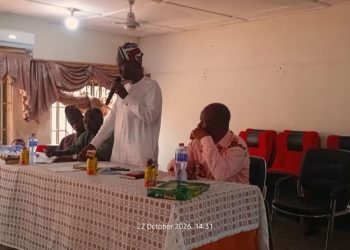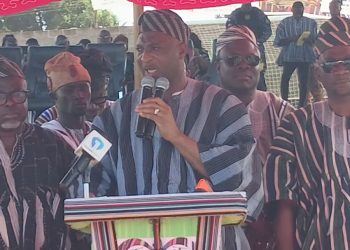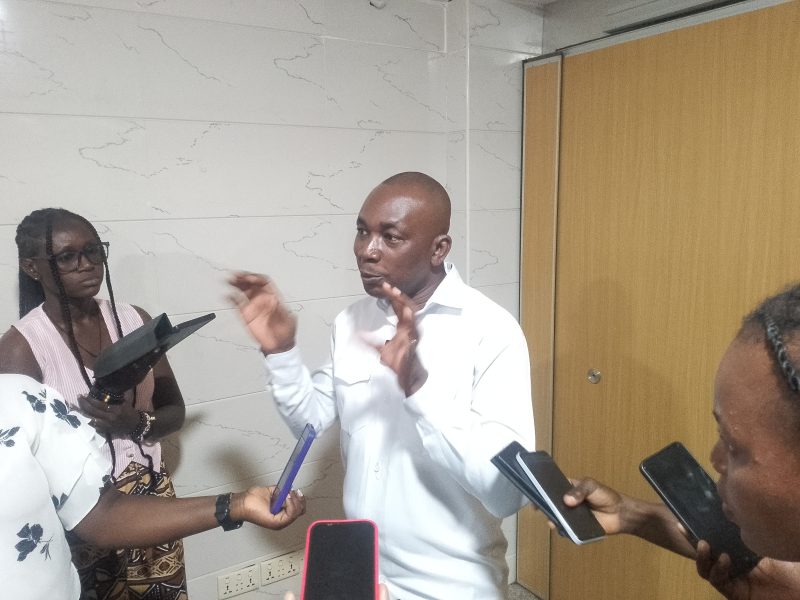
The Deutsche Gesellschaft für Internationale Zusammenarbeit (GIZ), through its Participation, Accountability and Integrity for a Resilient Democracy (PAIReD) programme, has organized a two-day training workshop for 42 journalists on Public Financial Management (PFM).
The training, supported by the Swiss State Secretariat for Economic Affairs (SECO), aimed at equipping journalists with the knowledge and skills needed to effectively report on public financial management issues and promote accountability at both the national and local levels.
Speaking during the training, economist and finance professor, Prof. Geoffrey A. Bokpin, took participants through the three key sectors of public financial management: the real sector, the fiscal sector, and the monetary sector.
Addressing the role of the media, Prof. Bokpin described journalists as the mouthpiece of the people, emphasizing that millions of citizens rely on radio, television, and other media platforms daily for information.
According to him, if journalists are not adequately informed about public financial management issues, duty bearers may not be held accountable for their actions.
“The media plays a critical role in ensuring accountability. When the media is well-informed, public officials are more likely to take their responsibilities seriously,” he stated.
Prof. Bokpin further noted that Ghana’s challenge is not necessarily a lack of revenue generation but rather the ineffective allocation and utilization of public resources.
“It is not that the country is not generating enough revenue. The major challenge lies in the allocation and effective use of resources, which in many cases points to corruption,” he said.
He encouraged journalists to pay greater attention to public financial management at the local government level by monitoring how composite budgets and annual action plans are prepared and implemented.
He also urged the media to scrutinize financial allocations to Metropolitan, Municipal and District Assemblies (MMDAs) and assess compliance with national development planning policies.

For his part, Alhaji Aliu Aminu (PhD), a representative of the PAIReD programme, stated that the public financial management ecosystem is evolving rapidly, making continuous capacity-building for journalists essential.
He explained that strengthening media understanding of public financial management is crucial to achieving the objectives of transparency, accountability, and inclusive development.
Referring to the Sustainable Development Goals (SDGs), Alhaji Amin noted that the principle of “leaving no one behind” can only be achieved if public financial management issues are effectively communicated to citizens and stakeholders.
“The media is a critical stakeholder in promoting public understanding of how public resources are allocated and utilized,” he said.
He added that the training was designed to equip journalists with the skills needed to engage stakeholders and report effectively on financial management operations at the district and local government levels.
Alhaji Amin identified three key areas of public expenditure management at the district assembly level: resource allocation, fiscal discipline, and effective service delivery.
He further emphasized that the media’s role is to provide oversight and ensure checks and balances in the management of public resources rather than attacking public officials.
Instead, he advised journalists to engage constructively with duty bearers and educate citizens on public financial management issues to promote transparency, accountability, and improved service delivery.
The training forms part of ongoing efforts by GIZ and its partners to strengthen democratic governance through enhanced citizen participation, accountability, and integrity in public resource management.
Source yagbonradioonline


Ray ID: 8f3a2c1b9d4e5f6a · Performance & security by Cloudflare
site-verification-ok